
Architectural Informatics Lab
Yasushi Ikeda Laboratory
Sustainable Digital Wood
Members: Suoao Wang, Zewei Feng, Boqiang Liu, Kazunori Nakayama

Spatial Formation Using Bundled Construction with Reclaimed Timber
By applying the bundled construction method, a high degree of spatial flexibility can be achieved. Even reclaimed timber with varying dimensions and conditions can be reused to the greatest extent, as the system is not constrained by uniform material specifications. Furthermore, the spatial configuration can be flexibly modified in response to changing functional requirements by taking advantage of the characteristics of the bundled construction method.

Automated Design System Based on Bundled Construction
By utilizing programming and algorithmic techniques, it is possible to automate both the configuration of structural forms and the selection and placement of reclaimed timber in accordance with the rules of the bundled construction method.

Automation of Processing and Construction Using Reclaimed Timber Based on Bundled Construction
Based on the digital data of the automatically designed structural form and the reclaimed timber to be used, both the processing of timber and the construction of the structure can be automated through robotic systems.

Establishing a Concept for Information Technology Development Toward “SUSTAINABLE DIGITAL WOOD”. Design proposal showcasing the bundled construction method and related technologies

This project aims to develop circular timber architecture, or “Digital Wood Architecture,” that enables a circular economy by drawing on traditional woodworking techniques while addressing the heterogeneous nature of timber, its workability, and its recyclability. (Collaborative Research with Azusa Sekkei)
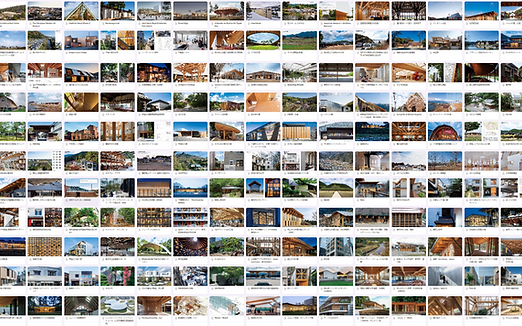
Around 800 cases on timber structures and wooden architecture were compiled to explore the potential of circular timber architecture using advanced information technologies. This collection provided a foundation for technical and conceptual frameworks for future projects, while the accumulated achievements and examples strengthened the credibility of proposed ideas.

In the demolition of Koevo House, BIM and 3D scanning technology were used to consider demolition methods, predict demolition dates, record waste materials, and recycle and reuse CLT materials.

3D BIM simulation of the deconstruction process in Navis Works. It allows us to plan for the deconstruction much more efficiently.

Reuse of the deconstructed CLT panels in an exhibition, showing the potential of recycling through the use of BIM in deconstruction.

This is a joint research project with Azusa Sekkei, and will involve the cooperation of Professor Kondo of the building method and Professor Koshihara of the structure method. This project will start from the planning stage in order to build a "Digital Wood Laboratory" in the future as a model project for recycling-oriented wooden architecture.